I recently completed a very special engagement ring for a friend of many years. He came to me knowing the style of my work and wanted something that was the same in design, but with just a few modifications of size and configuration. He was also looking for a very special colored stone for the ring.
Of all the jewelry I make, the rings are the most tied up with emotion. The couple is usually very nervous and, besides a car, it is the largest purchase many of them have made up to this point. Add to that the fact that this ring will be the first step in their commitment to each other. Often both partners are in involved in selecting the ring. I am very wary of making a custom ring without any input from the person who will be wearing it.
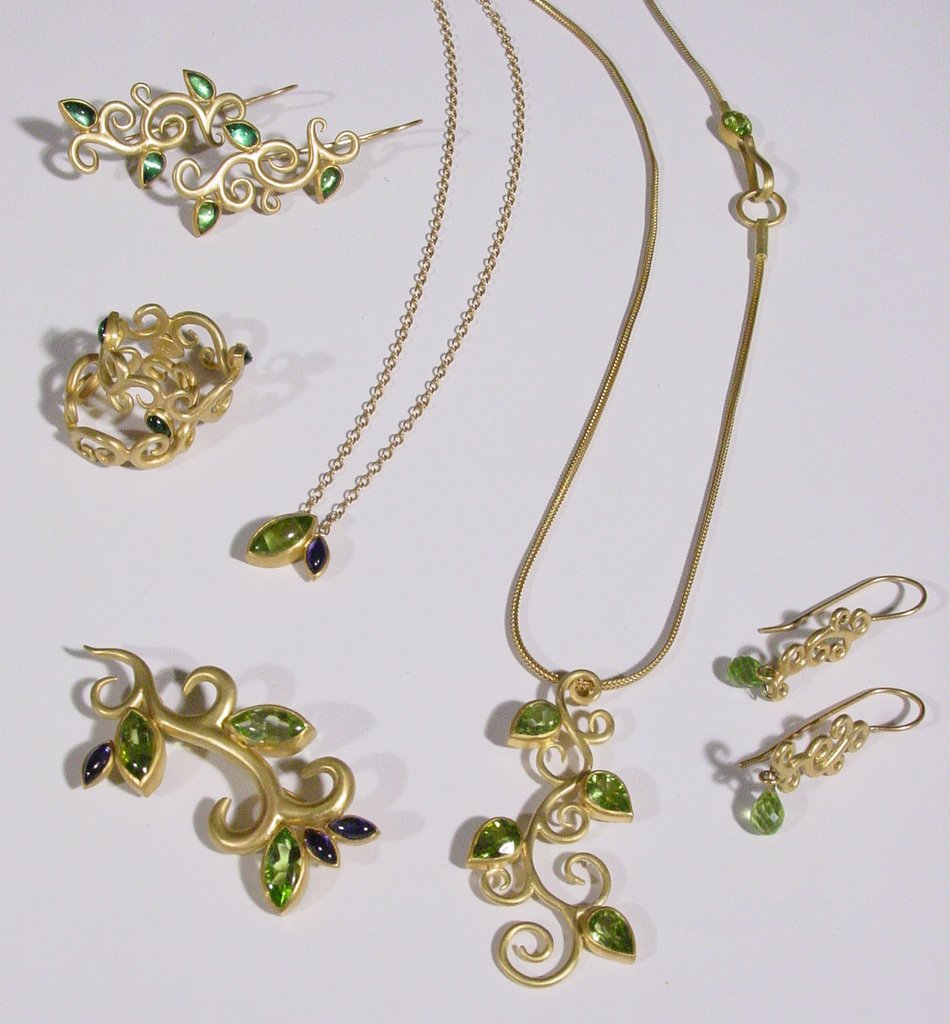
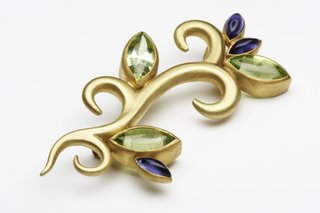
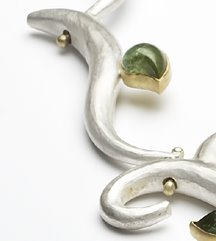
The ideal situation when doing custom work is for the client to know my work already and want to have a piece in my style. I have made very sleek and symmetrical rings, but in truth, I do the best when the ring is in the style that I use in a lot of my work. For example, all of the
curlicues. I make them all the time, so I am really, unusually good at them.
One of the challenges in making the engagement rings is the quest for the stone. In this case, I advised my client that emerald, his girlfriend's favorite stone, is too brittle for everyday wear and also not a good value for the money. So we decided on a tsavorite garnet. Not a stone that is commonly known, it is a very rare garnet that is bright green. In looking for this stone, I had to make contact with all of the people I know in the gem trade. In the size, shape and fine quality I was looking for, nobody had it in stock. Stones were called in from all over, I made the initial selection and ended up with these three for my client to choose from:

He decided to choose the stone on the right. It had the right shape, color and the cut was really beautiful.
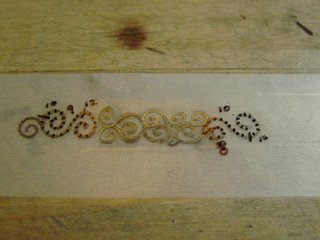 The initial drawing.
 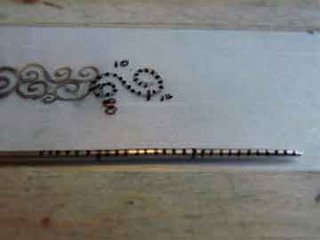 Marking the wire to match the size of the curls. Platinum is an extremely expensive metal, so I try to be precise and conserve every millimeter.
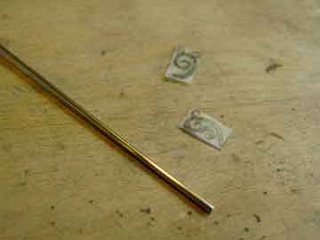 The drawings for the two side panels.
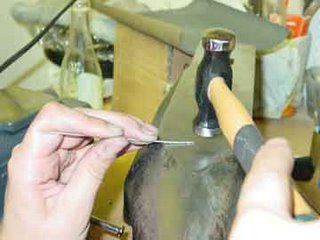
Hammering the wire to lengthen and taper it.

Smoothing out the hammer marks with an abrasive wheel.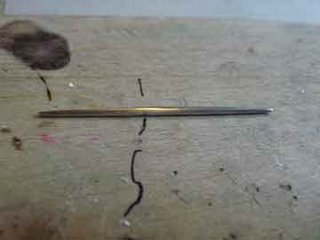 A double taper ready to be bent into an s-curl.
 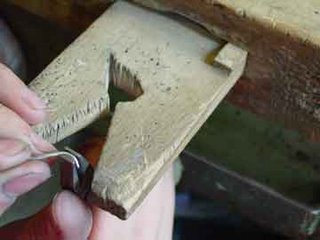 Gently bending the wire into shape.

After the first stage of bending. As the wire is bent, it becomes work hardened. Think of a paperclip that has been bent back and forth too many times.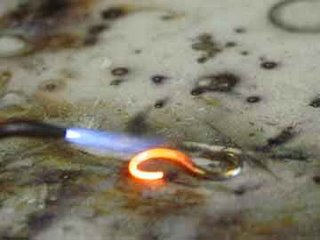 Annealing the curl. Platinum must be heated to a white hot temperature to become malleable again.
 After the second bending.
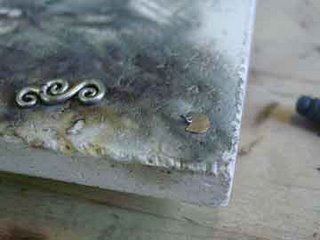 All of the curls are then pieced together one by one. Here is one full s-curl and a half curl that I will join using platinum solder.
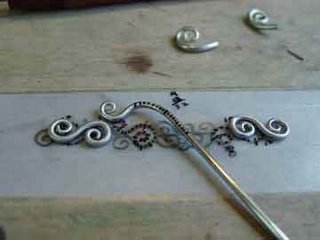 Each curl is bent carefully and the design is consulted to make sure it is the correct size, shape and proportion.
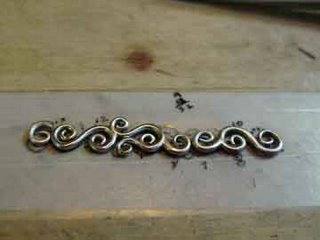 Almost finished fitting the curls together.
 The flat arrangement of curls is bent around a steel tool called a ring mandrel.
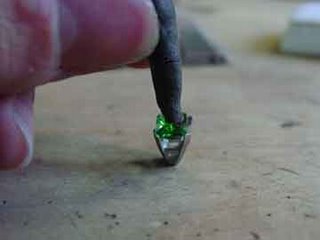 The stone must be fitted exactly into the setting for a tight and secure fit. At this point I become very familiar with every little idiosyncrasy in the faceting of the stone. In the world of jewelers, a tenth of a millimeter is quite large!
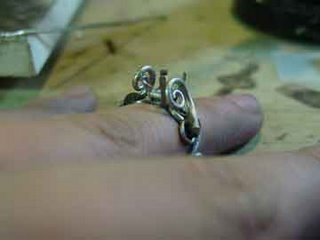 The side panels needed to be integrated into the pattern that was underlying it. At this point, the side panels were stuck on with wax to plan how they would be fit for soldering onto the ring.
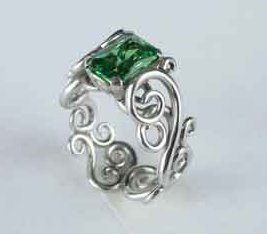 I got very involved with the process after that point and concentrated on the work rather than the photos. Here it is, after many minute adjustments and some obsessive hours of sanding and polishing.
 Blue Brooch



 The initial drawing.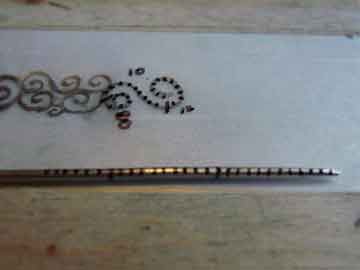
 The drawings for the two side panels.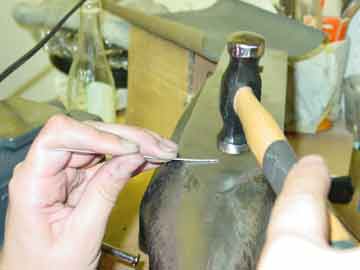

 A double taper ready to be bent into an s-curl.
  Gently bending the wire into shape.
 Annealing the curl. Platinum must be heated to a white hot temperature to become malleable again.
 After the second bending.
 All of the curls are then pieced together one by one. Here is one full s-curl and a half curl that I will join using platinum solder.
 Each curl is bent carefully and the design is consulted to make sure it is the correct size, shape and proportion.
 Almost finished fitting the curls together.
 The flat arrangement of curls is bent around a steel tool called a ring mandrel.
 The stone must be fitted exactly into the setting for a tight and secure fit. At this point I become very familiar with every little idiosyncrasy in the faceting of the stone. In the world of jewelers, a tenth of a millimeter is quite large!
 The side panels needed to be integrated into the pattern that was underlying it. At this point, the side panels were stuck on with wax to plan how they would be fit for soldering onto the ring.
 I got very involved with the process after that point and concentrated on the work rather than the photos. Here it is, after many minute adjustments and some obsessive hours of sanding and polishing.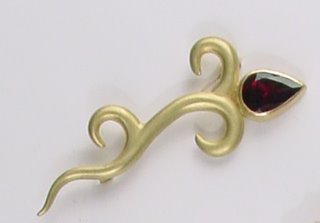

 These photos are by


